
So, let’s get started. To begin with, you need to understand what makes these ancient universities different from the rest.
Why Oxbridge Is Different (And Why That Matters)
Many students have similar confusion, but the fact is that, unlike every other UK university, you cannot apply to both Oxford and Cambridge. You must choose between these two ancient rivals. The acceptance rate hovers around 17-21%, which sounds intimidating, but that’s what makes it special. They don’t just want perfect grades. They want students who are genuinely curious, intellectually hungry, and ready to be challenged. Not students who are just good on paper. For students exploring options to study in the UK, Ahmedabad, Oxbridge represents the pinnacle, but it’s a specific kind of pinnacle that won’t suit everyone, and that’s perfectly fine.
The Academic Foundation: What Your Transcript Needs to Say
Here’s where most Indian students hit their first roadblock. Oxford explicitly states they don’t accept state board exams, NIOS qualifications, or JEE scores for undergraduate admissions. That elimination catches many students off guard.
So what DO they accept from India?
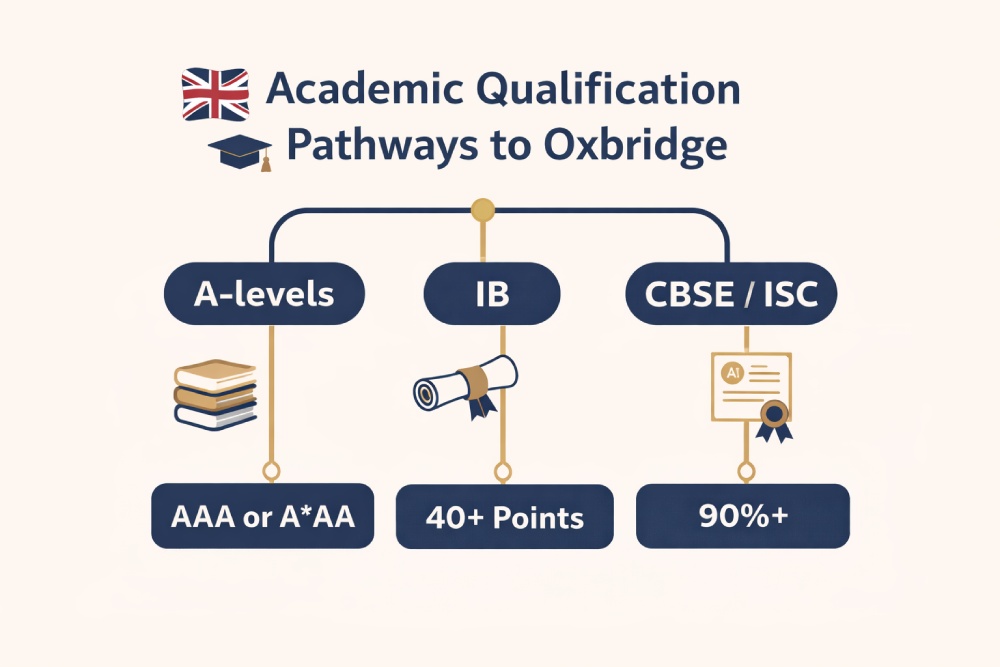
If you’re in CBSE or ISC, you need stellar scores. 85% minimum, but realistically, competitive applicants are hitting 90-95%. More importantly, you need 8s and 9s in the subjects that matter for your chosen course. Planning to study Economics? Your Mathematics score had better be exceptional.
Many students pursue A-levels (Cambridge International, Pearson Edexcel, or Oxford AQA) alongside or instead of Indian boards. The typical Oxbridge requirement sits at AAA to AAA. Yes, those are three A-grades, and some might need to be A-stars. The International Baccalaureate route requires 38-40 points total, with 6s and 7s in Higher Level subjects.
Those Infamous Admissions Tests

Oxbridge admissions tests are different; they don’t just test what you’ve memorized, they test how you think, how you approach problems you’ve never seen before, and whether you can handle intellectual pressure.
Besides this, Oxford has subject-specific tests like the MAT (Mathematics), PAT (Physics), UCAT (Medicine), and LNAT (Law). Cambridge recently introduced the ESAT for Engineering and Science, along with the TMUA for maths-heavy courses. These tests happen in October-November, and here’s the critical part: you need to register in September-October, roughly a year before you’d actually start university.
Most students underestimate these tests. They think, “I’m good at Physics, so the PAT should be fine.” Then they take a practice test and realize it’s asking them to apply physics concepts in ways they’ve never encountered. So starting the prep for the exam 2-3 months before the exam is crucial.
English Proficiency: More Than Just a Formality

You might be fluent in English. You might have studied in English-medium schools your entire life. But unless your entire secondary education was conducted in English, you’ll need to prove proficiency through tests like IELTS, TOEFL, or Cambridge English.
Oxford typically wants IELTS scores of 7.5 overall with no component below 7.0. Cambridge often requires even higher. These aren’t easy targets, especially the writing and speaking components, where many technically proficient English speakers struggle.
The good news? If your school conducted all instruction in English, you might be exempt. Check with the specific university and course to confirm.
The Personal Statement: Where Indian Students Often Stumble

Your UCAS personal statement is 4,000 characters, roughly 500-600 words, to convince Oxbridge you deserve a place. Most Indian students approach this like writing a resume in narrative form: “I did this. I achieved that. I led this club.”Cambridge explicitly states they care about academic passion and intellectual curiosity, not your volleyball trophy. They want to know: What have you read beyond your textbooks? What questions keep you awake at night? When did a concept in your subject genuinely excite you?
This requires a completely different mindset. Instead of writing “I participated in a chemistry research project,” you might write “Working with pH indicators made me question why anthocyanins change color, which led me down a rabbit hole about molecular structure that consumed my entire Diwali break.” See the difference? One lists an activity. The other reveals genuine curiosity and independent thinking.
Students seeking to study in the UK at Ahmedabad often benefit from guidance here, as the personal statement style is so different from Indian application essays. It’s not about sounding impressive; it’s about sounding genuinely engaged with your subject.
The Interview: An Academic Conversation, Not an Interrogation
If you make it to the interview stage, which only about 40-50% of applicants do, you’ll face at least two interviews in December. Many Indian students can now interview virtually, which eliminates travel costs but introduces new challenges (reliable internet, time zones, and creating a professional environment at home).
Here’s what surprises most students: Oxbridge interviews aren’t designed to test what you know. They’re designed to see how you think when pushed into unfamiliar territory. Your interviewer might give you a problem you’ve never seen, then watch how you approach it.
Interview questions can be anything. The way you respond to those questions will decide whether you are in or not. They test whether you can think on your feet. Do you ask good questions? When you’re wrong (and you will be), do you adapt or shut down?
The Reality for Indian Students: What Makes Your Journey Unique
Let’s address the elephant in the room: applying from India is harder. But we are here to make things easier for you. At Studea Advisory, we have helped many students achieve their dream of studying in Oxford and Cambridge.
Here’s all that you need to know.
The Predicted Grades Problem
Most Indian schools don’t do predicted grades. Your principal isn’t used to estimating what you’ll score on finals before you’ve taken them. But Oxbridge requires these predictions. You’ll need to work with your school to provide realistic forecasts based on your performance trajectory. Cambridge acknowledges that this varies by country, but having predictions strengthens your application significantly.
The Qualification Maze
State boards won’t cut it. If you’re in a state board school, you’ll need to pursue alternative qualifications like A-levels, IB, or multiple AP tests (five with scores of 5). This often means studying two curricula simultaneously, which requires exceptional time management and dedication.
Building Your Profile: It’s Not What You Think
Here’s where Oxbridge diverges dramatically from American universities or even other UK schools. They don’t want well-rounded students. They want students who are obsessed with their subject. Playing three sports, leading five clubs, and volunteering at ten organizations won’t impress them if your academic passion seems shallow. But spending your weekends reading graduate-level papers in your field, participating in relevant Olympiads, or conducting independent research? That catches their attention.
For example, one student got into Oxford for English Literature. Her extracurriculars? Minimal. But she’d read extensively, maintained a blog analyzing Victorian novels through a postcolonial lens, and could discuss literary theory with depth unusual for a seventeen-year-old. That’s what Oxbridge wants.
The Timeline: When to Start?
If you’re reading this in Class 11 or earlier: perfect timing. If you’re in Class 12 and haven’t started, you’re likely too late for this cycle, but you can plan for a gap year application.
The UCAS deadline is October 15, a full year before you’d start university. But admissions tests happen in October-November before that deadline, and test registration opens in September. So realistically, you need to be fully prepared by September of your Class 12 year (or equivalent).
Work backwards from there:
- Class 10: Explore subject interests deeply, start wide and serious reading, build academic habits, and get early exposure to Oxbridge-style thinking and problem-solving.
- Class 11 (Acceleration Year): Narrow down course choices, begin structured test preparation, pursue subject-specific supercurriculars (reading, MOOCs, Olympiads, projects), and start developing an academic profile.
- Class 12 (April-June): Finalize course choice, begin personal statement drafts
- Class 12 (July-September): Complete applications, register for tests
- Class 12 (October): Apply, take admissions tests
- Class 12 (December): Interviews
- Class 12 (January): Decisions arrive
Miss one deadline, and your application dies.
Common Mistakes That Kill Applications
Choosing the Wrong Course: You cannot change courses easily once admitted. Research obsessively before choosing.
Treating the Personal Statement Like a Resume: We’ve covered this, but it bears repeating. They don’t care about your Model UN participation unless you can connect it to genuine intellectual development in your chosen subject.
Underestimating the Admissions Test: This is the number one killer of otherwise strong applications. Students with 95% scores and strong statements get filtered out because they didn’t prepare adequately for the test.
Generic Subject Enthusiasm: Saying “I’ve always loved biology” means nothing. Explaining how reading “The Selfish Gene” made you question group selection theory shows genuine engagement.
Ignoring College Choices: You must select specific colleges when applying. Each has a different character, different tutors, and different strengths. Research matters.
Do You Need Professional Help?

Here’s an honest assessment: many successful applicants do seek guidance from experienced consultants, particularly those specifically familiar with Oxbridge. Quality overseas education consultancy Ahmedabad services help with course selection strategy, test preparation, statement editing, and interview prep.
Your consultants should enhance your application, not create it. Your personal statement must be your voice. Your interview answers must reflect your thinking. Consultants who offer templates or “guaranteed” formulas are wasting your money.
Good consultants ask questions that help you articulate what you already think and feel about your subject. They identify weaknesses in your preparation that you might miss. They provide structure to an overwhelming process.
Is Oxbridge Right for You?
Before you commit to this journey, ask yourself honestly: Do you genuinely love learning for its own sake, or do you love achievement? There’s a difference. Oxbridge suits the former. Can you handle being challenged constantly, sometimes uncomfortably? The tutorial system means discussing weekly essays or problem sets with your tutor and other students, then defending your thinking to experts who will poke holes in it. Having said that, it’s important to note that UK degrees focus on one subject. You won’t take breadth courses or explore different fields.
Making It Happen

Getting into Oxbridge from India is hard. Let’s not sugarcoat it. The academic requirements are steep, the application process is complex, the financial commitment is substantial, and the competition is fierce. But it’s also doable. Every year, students from Ahmedabad, across Gujarat, and throughout India receive those coveted offers. They’re not all geniuses (though some are). They’re students who started early, prepared thoroughly, presented themselves authentically, and demonstrated genuine passion for their subjects.
Whether you pursue this with support from consultants or navigate it independently, remember: Oxbridge isn’t looking for perfect students. They’re looking for interesting thinkers who will contribute to intellectual life on campus. Your job is to show them that’s exactly who you are.
The journey starts now. Make your first move. Here.