

The Question Every Gujarati Family Is Afraid to Ask
Every few months, a parent in Ahmedabad asks a version of the same question, sometimes quietly, sometimes embarrassed to say it aloud: my child studied in a Gujarati medium school. English is not their first language. They are brilliant, hardworking, and genuinely passionate about what they want to study. But is Ivy League even a realistic option for them?
The answer is yes. And this blog is going to explain exactly why — and exactly what it takes.
Language background does not determine your ceiling. Preparation, strategy, and genuine intellectual depth do. A student from a Gujarati medium school in Ahmedabad who understands this and starts early enough can absolutely compete for admission at Harvard, Yale, Princeton, and other elite global universities. What is required is not a transformation of who you are — it is a focused, structured plan to develop the specific skills these universities are looking for, while making the most of the unique story only a Gujarati medium student can tell.

What Ivy League Universities Actually Look For — And Why Language Is Not the Barrier You Think It Is
The first thing to understand is that Ivy League universities are not looking for students who speak English as though they were born in London or New York. They are looking for students who think clearly, communicate authentically, and have something genuinely original to bring to their campus community.
According to Yale Daily News reporting on Yale’s admissions process for international students (https://yaledailynews.com/blog/2023/02/01/yale-offers-flexibility-in-english-proficiency-evaluation-for-international-applicants/ ), Yale’s admissions officers make clear that English proficiency test scores are evaluated as one piece of a larger story — and that Yale does not employ cut-offs for any metric. The admissions office explicitly stated: “Whether it’s proficiency testing or an SAT score or grades or anything else, we look at application elements in context of resources available to students and other background factors.” That is a direct acknowledgement that a student from a non-English background is not being judged against a student who went to an English-medium international school. They are being judged in the context of what was available to them — and what they did with it.
This matters enormously for students from Gujarati medium schools. You are not being compared to students from DPS or international schools in Bengaluru. You are being compared to what any student in your situation could have done — and if you have gone further, worked harder, and built more than that baseline, it shows.
What this means in practice is that a Gujarati medium student who has developed strong English skills through deliberate effort, achieved competitive SAT or ACT scores through sustained preparation, built a meaningful spike activity that connects to their field of interest, and can write an authentic personal statement in their own voice — has a real, credible path to Ivy League admission.
The Tests You Need to Know — And What Scores You Are Aiming For
There are two categories of standardised tests relevant to a Gujarati medium student applying to Ivy League universities: academic aptitude tests and English language proficiency tests.
For academic aptitude, the SAT remains the primary requirement. According to US News and World Report’s guidance on international college admissions (https://www.usnews.com/education/best-colleges/articles/2018-06-18/whats-a-good-toefl-score-for-us-colleges-graduate-schools ) , Harvard, Yale, Brown, Dartmouth and Cornell reinstated mandatory SAT or ACT requirements starting from the Class of 2029. Columbia and Princeton remain test-optional as of 2026, but submitting strong scores still strengthens any application significantly. The competitive SAT range for Indian students at top Ivy League schools is between 1500 and 1580. For a Gujarati medium student, this is absolutely achievable — but it requires starting preparation early, ideally in Class 9 or 10, and being systematic about both the Math and Evidence-Based Reading and Writing sections.
For English language proficiency, most Ivy League universities require international students whose primary medium of instruction was not English to submit TOEFL or IELTS scores. The TOEFL underwent significant changes in January 2026, including a new scoring scale and adaptive sections. Yale accepts multiple alternatives including IELTS and Cambridge English Qualifications and has made clear that the goal is simply to confirm that a student can function in an English-language academic environment — not to penalise students for having learned primarily in another language.
Dartmouth and Cornell typically require an overall IELTS score above 7.0 for international applicants. Harvard and Yale assess scores holistically. For a Gujarati medium student, the TOEFL or IELTS is best approached as an achievable target — not an insurmountable wall — if preparation begins two to three years before application.
The good news is that the SAT’s reading and writing section and the TOEFL test many of the same skills. A student who builds strong English reading habits from Class 9 — reading English newspapers, novels, and non-fiction regularly — will find that their TOEFL and SAT preparation become mutually reinforcing rather than separate burdens. See Studea’s Process Flow (https://studea.in/process-flow-study-abroad-admission-planning/) for a grade-by-grade roadmap on when and how to schedule these tests.
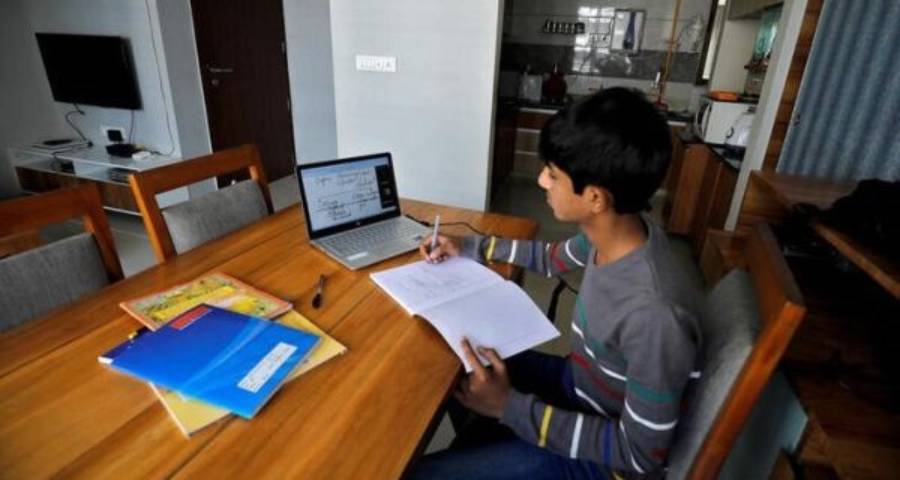
How to Build English Skills Starting From Where You Are
This is the section most Gujarati medium students need most, and it is also the section where the advice is most practical.
The most important thing to understand is that English is a learnable skill — not a fixed ability. Every admissions officer at Harvard and Yale knows this. A student who learned English primarily as a second language and has worked deliberately to develop it over three or four years can write a personal statement that is more honest, more specific, and more compelling than a student who has spoken English since birth but has nothing original to say.
According to US News and World Report’s guidance on how international students can improve English skills (https://www.usnews.com/education/best-colleges/articles/2019-09-09/how-international-students-can-practice-speaking-english ), students who build English proficiency most effectively do so through immersion in everyday language — not just academic texts. Reading tabloid newspapers, watching English-language series and films, listening to podcasts, and having real conversations in English are all more effective for developing natural spoken fluency than studying grammar rules in isolation.
Here is a practical week-by-week approach for a Gujarati medium student in Ahmedabad starting from Class 9 or 10:
Reading: Start with English newspapers you enjoy — Times of India is a good beginning. Move to books that genuinely interest you in English. Do not start with the hardest books. Start with books you want to read. The goal is to build the habit of reading in English daily, not to feel like it is a chore.
Writing: Keep a short daily journal in English — even three sentences a day about what you noticed, thought about, or worked on. This builds written fluency faster than any grammar exercise. After six months of daily writing, the difference is remarkable.
Speaking: Find one person — a friend, a cousin, a teacher — willing to practice speaking English with you for fifteen to twenty minutes a few times a week. Speaking practice is where Gujarati medium students typically gain confidence fastest, because the vocabulary and ideas are already there — the only barrier is the medium.
Listening: Switch one hour of content consumption per day — music, YouTube, Netflix — to English. Do not force yourself to watch things you find boring. Watch English content in your areas of genuine interest. A student passionate about technology should watch English-language tech content. A student interested in history should watch English documentaries on topics they already love.
The reason this matters for Ivy League admissions is not just test scores. It is your personal statement. The strongest essays from Gujarati medium students will be the ones that are written in English but feel unmistakably Indian — specific to Ahmedabad, rooted in Gujarat, honest about the language journey itself. That story, told well, is one that very few applicants in the world can tell.

Your Language Journey Is Part of Your Story — Not a Weakness
Here is something that most guidance about Ivy League applications does not tell Gujarati medium students: the fact that you learned to operate in English as a second language is not a weakness in your application. It is potential material for one of the most compelling personal narratives in your entire file.
Think about what it actually means. You grew up thinking, dreaming, and learning in Gujarati — one of India’s oldest and richest languages, with a literary tradition stretching back centuries. You have access to a way of understanding the world, a set of cultural references, and a community of people that the vast majority of Ivy League applicants have never encountered. And you did the work of crossing a language barrier that most of your future classmates at Harvard or Yale will never have to navigate.
That is not a gap in your application. That is a story.
The student from Ahmedabad who grew up speaking Gujarati at home, who read Gujarati poetry with their grandmother, who watched their family navigate the world in a language that most global institutions ignore, and who then built the English skills necessary to compete at the highest level of global academia — that student has a perspective that enriches a Harvard classroom in ways that no amount of perfect English can replicate.
Yale Daily News reporting on international student admissions (https://yaledailynews.com/blog/2025/02/20/international-students-navigate-growing-competition-in-yale-admissions/ ) makes clear that Yale’s admissions dean has said the university is in the fortunate position of attracting an exceptionally strong pool of applicants from nearly every country in the world each cycle. What that means is that they are actively building a class with diverse perspectives and backgrounds — and a student who genuinely represents the Gujarati medium school experience in Ahmedabad, told honestly and specifically, represents a perspective that is rare in that pool.
The key is to present this narrative with confidence rather than apology. Do not frame your language background as something you had to overcome despite it being a disadvantage. Frame it as one of the many things that shaped who you are and how you see the world. For help building this narrative into a compelling application story, see Studea’s Narrative Building page (https://studea.in/narrative-building/ ).
Building the Rest of Your Profile — Marks, Extracurriculars, and Recommendations
Language skills and test scores are essential — but they are not all. A Gujarati medium student applying to an Ivy League university also needs a strong academic record, a genuine spike in an area of sustained interest, and recommendation letters from teachers who know them well.
On academic marks: aim for 90 percent or above consistently across your board exams. Most competitive Indian admits to top Ivy League schools have scores between 94 and 97 percent. However, Ivy League admissions committees evaluate academic performance in the context of the school you attended — a student who scored 93 percent at a Gujarati medium school with limited resources is being read differently from a student who scored 93 percent at an elite private school in Mumbai. The context matters.
On extracurriculars: your spike should connect to your intended field of study and should be rooted in something real to your context in Gujarat. A student interested in environmental science might document water quality issues in their local area of Ahmedabad. A student interested in social policy might lead a literacy initiative in their neighbourhood. A student interested in business might run a small enterprise connected to their family’s trade or industry. These are activities that only a student from Gujarat can do — and that is precisely their value.
On recommendations: the teachers who write your letters of recommendation should know you well enough to describe you as a person, not just as a student. In a Gujarati medium school, this often means a Class teacher or subject teacher who has seen you develop over multiple years. Start building those relationships early, and let your teachers see the full depth of who you are — not just your exam performance. Visit Studea’s Profile Building page (https://studea.in/profile-building/) for guidance on how to present this full picture in your application.
Conclusion: The Path Is Real — But It Requires Starting Now
The path from a Gujarati medium school in Ahmedabad to an Ivy League university is not a fantasy. It is a real path that real students have walked — and it is a path that becomes more navigable the earlier you begin.
What it requires is honest assessment of where your English skills are today and a structured plan to develop them. It requires early and focused preparation for the SAT and TOEFL. It requires building a genuine, sustained spike in an area that connects to your academic direction. It requires teachers who know you well. And it requires the confidence to present your story — including the language journey — as something of real value, not as something to hide or apologise for.
Every Gujarati medium student who reads this blog and starts working on these things today is a student who is making that path more real. The question is not whether you are the kind of person who can get into an Ivy League university. The question is whether you are willing to do the work that the path requires.
At Studea Advisory, we work with students from Gujarati medium schools across Ahmedabad and Gujarat to build exactly the kind of profiles and applications we have described in this blog. If you are a student or parent who wants to understand what this path looks like for your specific situation, book a free counselling session today (https://studea.in/contact-us/ ).